Support our educational content for free when you purchase through links on our site. Learn more
Holistic Virtual Fitness Coaching: Train Beyond the Workout 🌿

Holistic virtual fitness coaching pairs personalized online training with practical support for the habits that shape your well-being, including recovery, sleep, stress, and motivation. Choose a qualified coach who tailors exercise to your life, respects professional boundaries, and helps you build routines you can sustain—not someone promising to fix everything with one perfect plan.
A client might start out wanting stronger workouts, only to realize that late meetings keep derailing training. The best coaching response isn’t a lecture about willpower; it’s a shorter session that fits the week, plus a check-in to see whether the adjustment works. That’s holistic coaching in practice: thoughtful, personal, and grounded in real life.
Key Takeaways
- Holistic coaching connects fitness with everyday habits such as sleep, stress management, nutrition, and recovery.
- Personalization matters more than the label. Ask how workouts, check-ins, and progress reviews will be tailored to your goals and schedule.
- Check credentials and boundaries. A fitness coach is not automatically qualified to provide medical care, therapy, or individualized nutrition treatment.
- Measure progress broadly: consistency, strength, stamina, mobility, confidence, and energy can matter as much as scale weight.
- Start with a manageable plan and adjust it with your coach as your needs and circumstances change.
Table of Contents
- ⚡️ Quick Tips and Facts
- 🌿 What Is Holistic Virtual Fitness Coaching?
- How Fitness Coaching Fits Into Holistic Health
- Virtual Coaching, Online Personal Training, and Wellness Coaching Explained
- 📚 Background: The Rise of Holistic Online Fitness Coaching
- 🧩 The Core Pillars of a Holistic Fitness Plan
- Strength, Cardio, Mobility, and Everyday Movement
- Nutrition, Hydration, and Sustainable Eating Habits
- Sleep, Stress Management, and Recovery
- Mindset, Motivation, and Behavior Change
- ✅ Benefits of Holistic Virtual Fitness Coaching
- 🧑 💻 How Online Holistic Personal Training Works
- Initial Assessment and Goal Setting
- Personalized Workout Programming and Progress Tracking
- Coaching Check-Ins, Feedback, and Accountability
- Live Video Sessions, On-Demand Workouts, and Hybrid Support
- 🎯 Choosing Goals That Fit Your Health, Schedule, and Starting Point
- 🏋️ Building a Balanced Holistic Workout Plan at Home
- Training Frequency, Workout Length, and Rest Days
- Bodyweight, Dumbell, Resistance-Band, and Gym Options
- Adapting Workouts for Beginners, Busy Schedules, and Limited Mobility
- 🥗 Nutrition Coaching: What a Fitness Coach Can—and Can’t—Do
- 😴 Recovery, Sleep, Stress, and Injury-Aware Training
- 📱 Fitness Apps, Wearables, and Online Coaching Technology
- 💰 What to Look for in a Holistic Virtual Fitness Coach
- Credentials, Experience, and Professional Scope
- Communication Style, Coaching Approach, and Inclusivity
- Questions to Ask Before Choosing a Coach
- Red Flags and Unrealistic Fitness Promises
- 🔍 Comparing Online Personal Training and Holistic Coaching
- 🚀 Getting Started: Your First Month of Virtual Fitness Coaching
- 📈 Measuring Progress Beyond the Scale
- 🛡️ Safety, Privacy, and When to Consult a Health Professional
- ✨ A Stronger Coaching Experience Starts With You
- Conclusion
- Recommended Links
- FAQ
- Reference Links
⚡️ Quick Tips and Facts
Holistic virtual fitness coaching combines online personal training with practical support for the habits that shape your health: movement, nutrition, sleep, stress management, recovery, and motivation. It isn’t a magic app that fixes everything. It’s a coaching relationship that helps you build routines you can actually keep.
If you’re comparing apps and online support, start with our guide to personal trainer apps, then use the checklist below to judge whether a coach’s approach is genuinely holistic.
| Quick fact | What it means for you |
|---|---|
| Holistic doesn’t mean “alternative medicine.” | It means considering the person and their circumstances, not just the workout. |
| Online coaching can be personalized. | A good coach adjusts the plan to your goals, equipment, schedule, experience, and feedback. |
| A coach is not automatically a dietitian or therapist. | Training and wellness credentials have different scopes of practice. |
| Recovery belongs in the plan. | Sleep, rest, stress, and training load affect how sustainable exercise feels. |
| Progress is bigger than a number on a scale. | Strength, stamina, energy, mobility, confidence, and consistency all count. |
Quick-start checklist
- ✅ Look for a coach with relevant, verifiable qualifications and clear professional boundaries.
- ✅ Ask how workouts are adapted when you’re tired, traveling, sore, or short on time.
- ✅ Make sure the plan includes realistic check-ins—not just a workout PDF and a cheerful “good luck!”
- ✅ Tell your coach about relevant medical conditions, injuries, medications, and exercise restrictions.
- ❌ Be cautious of guaranteed results, extreme food rules, “detox” claims, or advice to stop prescribed treatment.
- ❌ Don’t treat wearable data as a diagnosis. A watch can estimate; it can’t replace a clinician.
For a broader look at habit-building and wellness ideas, browse our Health and Wellness Tips and Fitness Motivation articles. The central question is simple: what should a coach support beyond the workout? The answer starts with the meaning of “holistic.”
🌿 What Is Holistic Virtual Fitness Coaching?
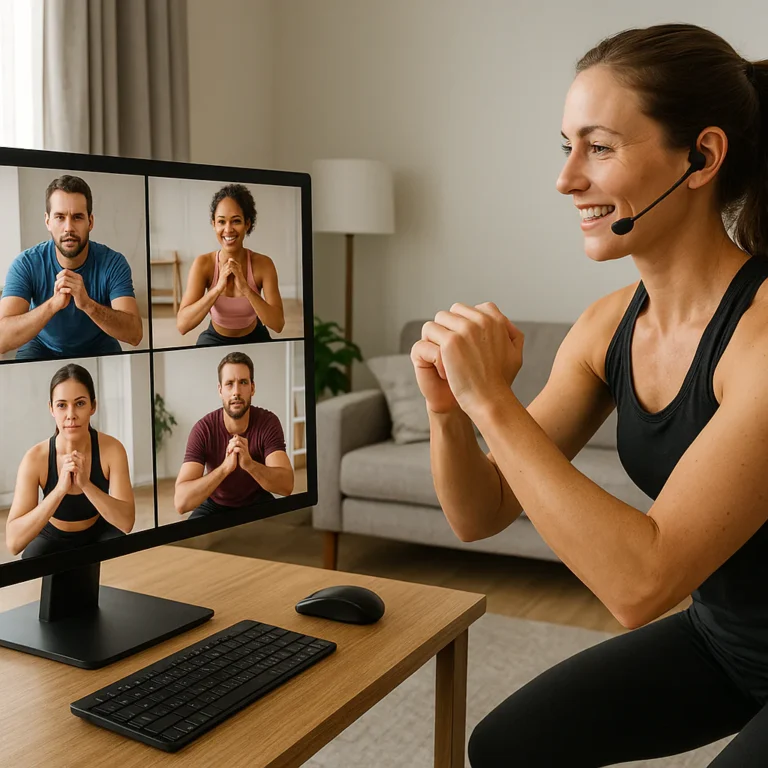
Holistic virtual fitness coaching is remote, individualized support for exercise and the lifestyle behaviors around it. Depending on the coach’s qualifications and the service you choose, it may include live video training, a customized workout plan, habit coaching, progress reviews, and referrals to other health professionals when needed.
“Holistic” should mean connected and person-centered, not that one coach claims to treat every condition. Your training plan doesn’t exist in a vacuum: work demands, caregiving, sleep, stress, food access, confidence, and past experiences can all affect whether a routine is workable.
The National Academy of Sports Medicine (NASM) describes wellness as a continuing process, distinguishing it from health as a desired outcome. Its article also frames coaching as broader than exercise instruction: movement matters, but so do nutrition, recovery, mental well-being, and social connection.
How Fitness Coaching Fits Into Holistic Health
A conventional training session may focus on the exercises you do today. A holistic coach also asks whether the overall plan fits your life and supports your well-being.
That could mean:
- Replacing a long workout with a short strength session during a stressful workweek.
- Building in recovery after a demanding training block.
- Setting a practical walking goal if you’re not ready for structured exercise.
- Helping you identify barriers—like an unpredictable schedule—rather than calling missed workouts a lack of discipline.
- Referring you to a registered dietitian, physical therapist, physician, or mental-health professional when the question is outside the coach’s expertise.
The U.S. Army’s Holistic Health and Fitness (H2F) framework offers a useful example of integrated thinking. It connects physical readiness with sleep, nutrition, mental fitness, and other factors. H2F is a military readiness model—not a consumer virtual coaching service—but it illustrates why performance and well-being are often considered together.
Virtual Coaching, Online Personal Training, and Wellness Coaching Explained
These terms overlap, but they don’t always describe the same service. Ask what the coach actually delivers rather than relying on a label.
| Service type | Typical focus | Common format | What to check |
|---|---|---|---|
| Virtual personal training | Exercise instruction, technique, strength, conditioning | Live video, programmed workouts, or both | Coach credentials, exercise modifications, feedback |
| Online fitness coaching | Workout programming, accountability, progress review | App, messaging, video calls | How often plans are updated and questions answered |
| Holistic wellness coaching | Lifestyle habits, motivation, goals, behavior change | Coaching conversations, check-ins, educational tools | Training and scope; referral process |
| Nutrition counseling | Individualized nutrition care and medical nutrition therapy | Usually delivered by a qualified nutrition professional | Verify the practitioner’s credentials and local regulations |
A coach might combine more than one role, but the service name does not expand their legal or professional scope. For example, a personal trainer can often discuss general healthy eating habits, but individualized medical nutrition therapy may require a registered dietitian or another qualified professional under local rules.
📚 Background: The Rise of Holistic Online Fitness Coaching

Online fitness coaching grew from a straightforward need: people wanted training support that could fit around real schedules, different locations, and home equipment. Video calls and training apps made it easier to connect with a coach without traveling to a gym. Wearables and digital platforms added new ways to log workouts and share feedback.
Holistic coaching reflects a broader shift from “Which workout should I do?” toward “What makes a healthy routine possible for me?” That shift is useful—but it also makes clear communication and professional boundaries more important.
What We Can Learn From H2F—and What We Can’t
The Army’s H2F model combines several performance areas and emphasizes individualized support. The Army article describes teams that may include physical therapists, registered dietitians, occupational therapists, athletic trainers, cognitive performance experts, and strength-and-conditioning coaches.
That multidisciplinary structure is a valuable lesson: complex needs often benefit from multiple qualified professionals, not one person attempting to be the trainer, dietitian, therapist, and physician all at once.
But H2F serves military readiness and operates in a distinct setting. Its facilities, staffing, and mission should not be treated as a consumer coaching blueprint. For individuals, the transferable principle is more modest and practical: coordinate support, personalize the plan, and refer out when appropriate.
Holistic Coaching Is Not a License to Make Big Claims
The wellness industry includes thoughtful, evidence-informed coaching—and bold claims that deserve a raised eyebrow. NASM notes that wellness coaching is not uniformly regulated as a single profession, making it especially important to check qualifications and ask what a coach is trained to do.
GMP Fitness, for example, lists online courses covering focused subjects such as nutrition, herbs, teas, and brain or heart health. Those course listings may be relevant to someone exploring education, but a course title or certificate alone does not establish licensure, clinical competence, or permission to diagnose or treat disease. Check the credentialing organization, curriculum, assessment requirements, and recognition within the relevant profession.
🧩 The Core Pillars of a Holistic Fitness Plan
There isn’t one universal checklist for a healthy life. Still, a useful coaching plan often looks at a handful of connected areas. NASM highlights nutrition, movement, sleep, stress management, and social connection; other frameworks, including H2F, also emphasize mental and spiritual dimensions.
| Pillar | Coaching may support | A reasonable first step |
|---|---|---|
| Movement | Strength, cardiovascular fitness, mobility, daily activity | Schedule two manageable workouts |
| Nutrition and hydration | General habits, meal routines, hydration awareness | Add a consistent meal or water break |
| Sleep and recovery | Rest routines, training-load adjustments | Set a more consistent wind-down time |
| Stress and emotional well-being | Reflection, coping habits, realistic planning | Identify one stress point the coach can help you plan around |
| Social support | Accountability, community, encouragement | Find a workout partner or supportive check-in |
| Coaching and behavior change | Goal setting, reflection, follow-through | Choose one small action to repeat this week |
Strength, Cardio, Mobility, and Everyday Movement
A balanced program can include resistance training, aerobic activity, and movement that helps you manage day-to-day tasks. The Physical Activity Guidelines for Americans recommend that adults work toward 150–300 minutes of moderate-intensity aerobic activity per week, or an equivalent amount of vigorous activity, plus muscle-strengthening activity on at least two days a week.
Those are population-level guidelines—not a test you must pass before you “count” as active. If you’re starting from little or no activity, begin at a level you can repeat and increase gradually. A coach can help adapt exercise to your ability, equipment, and health history, while a clinician can advise on medical limitations.
A practical weekly mix might include:
- Two full-body strength sessions.
- Several walks, cycling sessions, or other aerobic activities.
- Brief mobility breaks when sitting for long stretches.
- Rest or lighter days as needed.
That is an example, not a prescription. Your actual plan should reflect your starting point and any professional guidance.
Nutrition, Hydration, and Sustainable Eating Habits
A responsible fitness coach can help you think through general habits—such as meal consistency or planning for busy days—within their training. They should not diagnose nutritional deficiencies, treat eating disorders, or prescribe a medical diet unless qualified and legally permitted to do so.
For dietary needs involving conditions such as diabetes, kidney disease, food allergies, gastrointestinal disorders, pregnancy, or a history of disordered eating, consult an appropriate clinician or registered dietitian. The Academy of Nutrition and Dietics offers resources and a way to find nutrition professionals in the United States.
Useful coaching questions include:
- What makes meals difficult on your busiest days?
- Are there practical options you enjoy and can access?
- Would a referral help you get more specialized guidance?
A sustainable plan shouldn’t turn every meal into a performance review. Food is nourishment, culture, pleasure, and routine—not a moral scoreboard.
Sleep, Stress Management, and Recovery
Training adaptation depends on more than showing up. Rest days, sleep, and manageable training load help create a routine you can sustain. The CDC’s sleep guidance recommends that adults generally get at least seven hours of sleep per night, while individual needs can vary.
A coach can help you notice patterns: perhaps your hardest workouts land after late shifts, or your recovery suffers when you schedule intense sessions back-to-back. They can adjust training and encourage basic habits, but sleep disorders, persistent insomnia, and significant mental-health symptoms warrant qualified clinical support.
Try this simple recovery check before training:
- How did you sleep?
- How do your energy and soreness feel today?
- Is the planned session still appropriate?
- Would a lighter session, walk, or rest be the smarter choice?
Mindset, Motivation, and Behavior Change
Motivation comes and goes. A useful coach helps you create a plan that doesn’t depend on feeling inspired every Tuesday at 6 a.m.
That can involve:
- Breaking a large goal into repeatable actions.
- Identifying barriers before they derail the week.
- Reviewing what worked without shaming what didn’t.
- Helping you choose goals that matter to you—not only goals that look impressive online.
NASM discusses behavior-change models such as the Transtheoretical Model as tools for understanding readiness. In practice, this means a coach might help you explore whether you’re ready to start, still weighing options, or prepared to build consistency. The coach’s role is to support your choices, not take control of them.
✅ Benefits of Holistic Virtual Fitness Coaching
The biggest benefit is coordination. Instead of treating workouts, sleep, motivation, and schedule constraints as unrelated problems, a coach can help you connect them and make a plan that fits.
Potential Benefits
- Flexible access: Train at home, outdoors, or in a gym, depending on the service.
- Individualized exercise: Adjust movements, volume, and equipment to your needs.
- Accountability: Regular check-ins can help turn intentions into repeatable actions.
- More context: A coach can discuss how schedule, stress, and recovery affect training.
- Skill development: Learn exercise technique and how to modify workouts.
- Progress beyond weight: Track strength, stamina, mobility, confidence, or workout consistency.
- Support between sessions: Some services offer messaging or app-based feedback—check the actual terms.
Trade-Offs to Consider
- Less hands-on correction: A video coach may not see every movement angle.
- Technology friction: Internet access, camera setup, and app comfort can affect the experience.
- Variable availability: Message response times and coaching frequency differ.
- Scope confusion: “Holistic” branding can blur the line between coaching and clinical care.
- Self-direction: Many online plans require you to manage your own space, schedule, and equipment.
We recommend a coach who is confident enough to support your goals—and sensible enough to say, “That’s outside my scope; let’s involve the right professional.” You can keep up with developments in digital training through our Fitness Industry News and explore Fitness App Reviews when comparing platforms.
🧑 💻 How Online Holistic Personal Training Works
Online coaching can be highly structured or pleasantly simple. Before signing up, ask how the program moves from assessment to training to review. A coach should explain the process in plain language—not hide behind a shiny app dashboard.
Initial Assessment and Goal Setting
A thoughtful intake may ask about:
- Your training background and current activity.
- Goals, preferences, and what success would look like.
- Available time, equipment, space, and budget constraints.
- Injuries, medical conditions, medication considerations, or exercise restrictions.
- Sleep, stress, and recovery patterns relevant to training.
- Communication preferences and accessibility needs.
You do not need to disclose every personal detail to a trainer. Share information relevant to safe, appropriate coaching, and ask how the service protects your data.
Goals work best when they are specific enough to guide action and flexible enough to survive a messy week. Instead of “get fit,” a starting goal might be: complete two 25-minute strength sessions each week for four weeks, then review how it feels.
Personalized Workout Programming and Progress Tracking
A coach should be able to explain why your plan contains the exercises it does, how to scale them, and what to do if something feels wrong. A useful program generally includes:
- A warm-up suited to the session.
- Exercises matched to your experience and equipment.
- Clear sets, repetitions, effort guidance, or time targets.
- Rest periods and modification options.
- A cool-down or recovery note when appropriate.
Progress tracking can be simple: completed workouts, exercise loads, perceived effort, walking time, or how you feel. Wearables from brands such as Garmin and Fitbit can provide activity estimates and trends, but their readings are not medical diagnoses. A coaching plan should not collapse into “the watch says so.”
Coaching Check-Ins, Feedback, and Accountability
A check-in should create a useful conversation, not a confession booth. It may cover what went well, what got in the way, and what adjustment would make the next week more realistic.
The first featured coaching video describes a six-step structure for a 60-minute health-coaching session: welcome and grounding, accountability check-in, agreeing on an agenda, exploring the client’s current state, action planning, and a wrap-up with reflections. Its central idea is that the coach facilitates the process while the client stays at the center.
That distinction matters. Accountability is not punishment. A good coach helps you understand the gap between intention and action, then decide what to try next.
Live Video Sessions, On-Demand Workouts, and Hybrid Support
| Format | Works well when you want… | Possible limitation |
|---|---|---|
| Live video training | Real-time cues and a scheduled appointment | Camera placement and internet quality matter |
| On-demand workouts | Flexibility and independent sessions | Technique feedback may be limited |
| App-based programming | A central place for workouts and logs | App features vary; notifications can become noise |
| Hybrid coaching | A blend of live sessions and independent training | Clarify how much support is actually included |
Ask how often the coach reviews your plan and whether feedback happens during a session, via messages, or only at a scheduled review. “Online support” can mean many things.
🎯 Choosing Goals That Fit Your Health, Schedule, and Starting Point
The best goal is not necessarily the most ambitious one. It is the one that gives you a meaningful direction while leaving room for real life.
A Step-by-Step Goal-Setting Method
- Name the reason. What do you want to feel, do, or improve?
- Choose an action you control. “Walk for 20 minutes” is more actionable than “be healthier.”
- Set a minimum version. Decide what counts on a busy day.
- Pick a tracking method. Use a calendar, training log, or app—whatever you’ll actually use.
- Review and adapt. Treat missed sessions as information about the plan, not a character flaw.
Try a simple goal ladder:
| Level | Example |
|---|---|
| Minimum | Take a 10-minute walk twice this week |
| Target | Walk 20 minutes on three days |
| Stretch | Add one longer walk if energy and schedule allow |
This approach avoids the classic trap: building a routine for your fantasy schedule, then blaming yourself when your actual schedule shows up.
🏋️ Building a Balanced Holistic Workout Plan at Home
A home workout plan can be effective without turning your living room into a commercial gym. Start with your goals and what you can do consistently; add equipment only if it makes the plan more useful.
Training Frequency, Workout Length, and Rest Days
For general health, public guidelines offer a useful destination: regular aerobic activity and strength work at least twice a week. Your starting program may be smaller. If you’re new to exercise, recovering from inactivity, or managing a health concern, start conservatively and seek professional guidance when needed.
A beginner-friendly template could look like this:
| Day | Example activity |
|---|---|
| Monday | Full-body strength |
| Tuesday | Comfortable walk or rest |
| Wednesday | Mobility or light activity |
| Thursday | Full-body strength |
| Friday | Rest or easy walk |
| Saturday | Enjoyable cardio activity |
| Sunday | Rest |
This is just a sample, not a universal prescription. A coach should account for training history, medical guidance, fatigue, and your ability to recover.
Bodyweight, Dumbell, Resistance-Band, and Gym Options
| Equipment option | Good for | Considerations |
|---|---|---|
| Bodyweight | Low-cost, minimal setup, movement practice | Progressions may need creativity |
| Resistance bands | Travel, small spaces, varied resistance | Inspect for wear and anchor securely |
| Dumbells | Scalable strength exercises | Requires safe storage and enough room |
| Gym equipment | More loading and exercise variety | Commute and access may limit consistency |
A virtual coach should give you substitutions. If your workout says “cable row” and you don’t own a cable station, “figure it out” is not programming. Ask whether the plan includes home-gym, no-equipment, or travel modifications.
Adapting Workouts for Beginners, Busy Schedules, and Limited Mobility
Good adaptation is not a lesser version of training. It is training that matches the person.
A coach may adjust:
- Exercise range of motion or body position.
- Session length and number of movements.
- Balance or impact demands.
- Rest intervals and intensity.
- Equipment and exercise order.
If you have pain, a recent injury, or a condition affecting movement, tell the coach and consult an appropriate health professional. Trainers can modify exercise within their competence, but they should not diagnose the cause of pain.
🥗 Nutrition Coaching: What a Fitness Coach Can—and Can’t—Do
The phrase “nutrition coaching” can mean basic habit support—or something much more clinical. Ask for specifics.
Generally Appropriate Coaching Topics
Depending on training, qualifications, and local rules, a fitness coach may be able to discuss broad topics such as:
- Planning meals around a busy schedule.
- Building consistent food routines.
- General hydration awareness.
- Basic nutrition education from recognized public-health guidance.
- Identifying when a referral is more appropriate.
When to Seek a Registered Dietitian or Clinician
A qualified nutrition professional is the better choice for medical nutrition therapy, individualized treatment of a disease, complex dietary restrictions, or concerns involving disordered eating. The Academy of Nutrition and Dietics explains the role of registered dietitian nutritionists and provides professional resources.
Be wary of detox plans, supplement prescriptions presented as essential, promises to cure disease through food, and extreme restrictions without appropriate clinical oversight. A good coach knows that “I don’t know—let’s refer you” is a professional answer, not a failure.
😴 Recovery, Sleep, Stress, and Injury-Aware Training
Training hard is only useful when the rest of your life can support it. Recovery-aware coaching takes your energy, sleep, soreness, and stress into account instead of assuming every week should look identical.
A Practical Recovery Review
Before progressing your training, check:
- Are you sleeping reasonably well for your needs?
- Is soreness improving between workouts?
- Do you feel able to complete normal daily tasks?
- Is your training load rising gradually?
- Are stress and schedule changes affecting your capacity?
If symptoms persist, worsen, or interfere with daily life, consult a qualified health professional. For urgent or severe symptoms, seek appropriate medical care rather than asking a training app to solve it.
Recovery Isn’t Just a Foam Roller
Recovery can include sleep, rest days, lighter sessions, enjoyable movement, and stress-management practices. Mindfulness or journaling may help some people reflect and slow down; they are supportive tools, not substitutes for mental-health care when that care is needed.
Our Health and Wellness Tips can offer general lifestyle ideas, but your personal needs may call for a clinician, physical therapist, or mental-health professional.
📱 Fitness Apps, Wearables, and Online Coaching Technology
Technology can make coaching easier to organize. It can also make a simple plan feel like a mission-control dashboard. Choose tools that serve the coaching relationship rather than burying you in metrics.
Useful Features to Compare
- Workout delivery and exercise demonstrations.
- Progress logs and coach feedback.
- Video-call compatibility.
- Wearable integration, if you want it.
- Accessibility, privacy, and data-export options.
- Clear communication about data storage and account deletion.
| Tool category | Examples | Useful for | Keep in mind |
|---|---|---|---|
| Fitness tracking | Garmin, Fitbit | Activity and training trends | Estimates can be imperfect |
| Workout platforms | Trainerize, TrueCoach | Program delivery and coach-client communication | Features and privacy practices differ |
| Video calls | Zoom, Google Meet | Live exercise coaching | Camera position and bandwidth affect feedback |
Before connecting health or wearable data, read the service’s privacy policy and ask who can access your information. For app comparisons, see our Fitness App Reviews.
💰 What to Look for in a Holistic Virtual Fitness Coach
A trustworthy coach should be able to explain their qualifications, services, limitations, and communication process without drowning you in jargon. “Holistic” is a description, not a credential.
Credentials, Experience, and Professional Scope
Check whether a coach holds a relevant credential from a recognized organization and whether it is current. Examples of fitness certification organizations include NASM, ACE, and ACSM. The right qualification depends on the service offered; a fitness certification is not the same as a clinical license.
Ask:
- What training and certifications do you hold?
- How do you keep your education current?
- What conditions or situations are outside your scope?
- When do you refer clients to another professional?
- Are you insured, if relevant to your location and service?
Communication Style, Coaching Approach, and Inclusivity
The coach should listen to your priorities, invite questions, and avoid shame-based language. You should feel able to say that a workout is painful, a goal no longer matters, or a plan isn’t working.
Look for a coach who:
- Offers realistic modifications.
- Respects cultural, accessibility, and body-size considerations.
- Focuses on skills and behavior, not just appearance.
- Makes expectations for messages and check-ins clear.
- Helps you build independence rather than dependence.
Questions to Ask Before Choosing a Coach
Use this shortlist on an introductory call:
- How do you assess my goals and starting point?
- How will you tailor workouts to my equipment and schedule?
- What happens if an exercise causes pain or I miss a week?
- How often do you review and update my program?
- What support is included between sessions?
- What are your qualifications and professional boundaries?
- How do you protect my personal and health information?
- Can I speak with a current or former client, or read verified reviews?
Reviews can help you assess communication and service reliability, but individual experiences aren’t proof that a program will produce the same results for everyone. Look for consistent themes rather than a single dramatic testimonial.
Red Flags and Unrealistic Fitness Promises
❌ Guaranteed rapid weight loss or “one plan works for everyone.”
❌ Claims to cure medical conditions through exercise, supplements, or food rules.
❌ Pressure to ignore pain, skip prescribed treatment, or train through illness.
❌ Shame, threats, or public comparison used as motivation.
❌ No clear explanation of credentials, privacy, or cancellation terms.
❌ A coach who presents every question as something they can solve alone.
A confident professional can still be humble. In health coaching, knowing when not to give advice is part of competence.
🔍 Comparing Online Personal Training and Holistic Coaching
Neither format is automatically better. The right choice depends on whether you need exercise-specific instruction, broader habit support, or a combination.
| Feature | Online personal training | Holistic virtual fitness coaching |
|---|---|---|
| Primary emphasis | Exercise programming and training performance | Exercise plus connected lifestyle habits |
| Typical support | Workouts, form cues, progression | Workouts, goals, habits, recovery, accountability |
| Best fit | You want a structured training plan | You want support connecting training with daily routines |
| Possible limitation | May not address broader barriers | Can become vague if the coach lacks clear scope |
| What to verify | Exercise qualifications and feedback | Qualifications, referrals, and specific services |
A service can offer both. Don’t choose based on a label alone: request a sample week, ask how communication works, and check who handles specialized nutrition or medical questions.
🚀 Getting Started: Your First Month of Virtual Fitness Coaching
A good first month should help you learn the process, build a manageable routine, and identify what needs adjustment. It doesn’t need to be a dramatic transformation montage.
Week 1: Establish Your Starting Point
- Discuss goals, schedule, equipment, and exercise history.
- Share relevant medical or injury information.
- Agree on communication and progress-tracking methods.
- Start with sessions that feel achievable.
Week 2: Practice the Plan
- Learn key movements and modifications.
- Track whether the planned schedule matches reality.
- Report discomfort, confusion, or equipment problems.
Week 3: Review Bariers
- Identify what helped you follow through.
- Decide whether session length, intensity, or timing needs adjustment.
- Ask for clarification instead of guessing at exercises.
Week 4: Evaluate and Set the Next Step
Review:
- How consistently you completed the plan.
- Whether workouts felt appropriately challenging.
- Changes in strength, stamina, confidence, or energy.
- Any new questions that require professional referral.
The best sign of a strong first month is not perfection. It’s a clearer understanding of what works for you.
📈 Measuring Progress Beyond the Scale
Weight can be one measurement if it is appropriate and meaningful to you, but it is not the only way to assess progress. A coach should respect your preferences and avoid making body weight the automatic center of every conversation.
| Progress marker | Example tracking method |
|---|---|
| Strength | Record exercise loads, repetitions, or movement quality |
| Cardiovascular fitness | Note walking pace, duration, or perceived effort |
| Consistency | Count completed workouts or active days |
| Mobility and function | Track a personally relevant task, such as stairs or carrying groceries |
| Recovery | Note sleep patterns, soreness, and readiness |
| Confidence and enjoyment | Brief weekly reflection or rating |
Use measures that support your well-being. If tracking increases anxiety, shame, or compulsive behavior, tell your coach and consider speaking with a qualified health professional.
🛡️ Safety, Privacy, and When to Consult a Health Professional
Virtual coaching can support exercise, but it doesn’t replace medical care. A coach should ask appropriate screening questions and encourage clinical guidance when your health history or symptoms warrant it.
Exercise Safety Basics
- Clear a stable, uncluttered space before training.
- Secure resistance bands and check equipment for damage.
- Position your camera so the coach can see the relevant movement.
- Stop if you experience concerning symptoms, such as chest pain, fainting, or severe shortness of breath, and seek appropriate medical care.
- Follow clinician instructions for injury, pregnancy, chronic conditions, or return-to-exercise decisions.
The American College of Sports Medicine and U.S. Physical Activity Guidelines offer useful evidence-based resources, but individual medical advice should come from your own healthcare professional.
Privacy and Personal Information
Before joining a platform, check:
- What information is collected.
- Whether health data is shared with third parties.
- Who can see workout logs or messages.
- How to delete or export your data.
- Whether video sessions are recorded.
Share only what is relevant, and ask questions if privacy terms are unclear. Convenience should not require giving up control of sensitive information.
✨ A Stronger Coaching Experience Starts With You
The strongest coaching relationship is a partnership. You bring your lived experience, preferences, and feedback; the coach brings exercise expertise, structure, and accountability. Both sides should be willing to adjust the plan.
That also answers the question we raised at the start: what should a coach support beyond the workout? The answer is the context that helps you train safely and consistently—while respecting the boundary between coaching and clinical care.
Before your first session, write down one goal, one concern, and one question. Then ask the coach to explain how the plan will adapt when life inevitably changes the schedule. A thoughtful answer is a better sign than a flashy promise.