Support our educational content for free when you purchase through links on our site. Learn more
What Workouts Can a Virtual Trainer Lead? 🏋️


A virtual personal trainer can coach weightlifting, bodyweight strength, yoga, Pilates, cardio, mobility, and interval workouts, then adapt them to your goals, fitness level, equipment, and space. So, “What types of workouts can I expect from a virtual personal trainer, such as weightlifting or yoga?” The answer is usually a flexible mix—not a webcam workout limited to counting reps.
We’ve seen how a simple change can make online training click: one client thought strength training meant buying a full home gym, but their trainer began with a sturdy chair, resistance bands, and a few carefully coached movements. As confidence grew, the plan progressed. You don’t need a fancy setup; you need a safe, personalized plan and clear coaching.
A live session can offer real-time cues and modifications, while recorded workouts are convenient but can’t see or correct your form. The right choice depends on what you want to do—and how much feedback you need.
Key Takeaways
- Expect variety: virtual trainers may coach weightlifting, bodyweight workouts, yoga, Pilates, cardio, mobility, and circuits.
- Your program should fit you: goals, experience, health needs, schedule, and available equipment all shape the plan.
- Live coaching offers feedback: camera setup matters, and remote instruction has limits.
- Start with manageable effort: progress gradually, prioritize good technique, and tell your trainer if an exercise causes pain.
- You can start simply: bodyweight movements, a clear space, and a stable chair may be enough for your first sessions.
Table of Contents
- ⚡️ Quick Tips and Facts
- 🏋️ What Workouts Can a Virtual Personal Trainer Lead?
- 1. Strength Training and Weightlifting
- 2. Bodyweight and Functional Fitness
- 3. Yoga, Mobility, and Stretching
- 4. Pilates and Core Training
- 5. Cardio and Endurance Workouts
- 6. HIT and Circuit Training
- 7. Low-Impact and Joint-Friendly Exercise
- 8. Sport-Specific and Performance Training
- 9. Prenatal, Postpartum, and Older-Adult Fitness
- 📚 How Virtual Personal Training Workouts Have Evolved
- 🧭 How Online Personal Training Sessions Work
- Live one-one personal training
- Semi-private and virtual group fitness classes
- On-demand workouts and hybrid coaching
- 🎯 Choosing Workouts for Your Goals, Fitness Level, and Schedule
- Weight loss, muscle building, and general fitness
- Beginer, intermediate, and advanced workout options
- Training at home with or without equipment
- 🗓️ What a Virtual Training Plan May Include
- Assessment, goal setting, and workout programming
- Progressive overload, recovery, and rest days
- Exercise demonstrations, feedback, and form checks
- 🛡️ Safety, Modifications, and Working Around Injuries
- 💻 Technology and Home Workout Setup
- 🤝 Finding the Right Virtual Personal Trainer
- Credentials, coaching style, and specialty expertise
- Questions to ask before your first session
- ✅ Quick Tips for Getting the Most From Online Workouts
- 🏁 Conclusion
- 🔗 Recommended Links
- ❓ FAQ
- Can a virtual personal trainer teach weightlifting?
- Can I do yoga or Pilates with an online trainer?
- Do I need gym equipment for virtual personal training?
- Can a trainer correct my form over video?
- How often should I meet with a virtual personal trainer?
- Are virtual personal training workouts safe for beginners?
- 📖 Reference Links
⚡️ Quick Tips and Facts
If you’re wondering what a virtual personal trainer can do for you, the short answer is: far more than count squats through a webcam. Depending on your goals, equipment, health history, and coaching format, sessions can include weightlifting, bodyweight strength, yoga, mobility, Pilates, cardio, high-intensity interval training (HIT), and sport-specific work.
| Quick fact | What it means for you |
|---|---|
| A virtual trainer can coach several workout styles | A good program may combine strength, cardio, mobility, and recovery rather than repeating one workout forever. |
| You don’t need a home gym | Bodyweight movements, resistance bands, and a backpack loaded with books can provide useful starting options. For heavier strength goals, dumbells or a barbell may help. |
| Live and recorded sessions are different | Live video allows real-time cueing and adjustments. Recorded classes offer convenience but cannot see or correct your technique. |
| Yoga is not one intensity | Restorative, gentle, and chair-based yoga differ greatly from power yoga or a fast vinyasa flow. |
| Consistency beats workout roulette | Your trainer should build a progression that matches your schedule and recovery, not just surprise you with increasingly dramatic burpees. |
| Pain deserves attention | Mild muscle effort is expected; sharp, worsening, or joint pain is a reason to stop and seek appropriate guidance. |
The U.S. Department of Health and Human Services recommends adults aim for 150–300 minutes of moderate-intensity aerobic activity per week and muscle-strengthening activities on two days per week. That’s a broad public-health target, not a personal prescription; a trainer can help you build toward it gradually. See the Physical Activity Guidelines for Americans.
🏋️ What Workouts Can a Virtual Personal Trainer Lead?
Virtual training is a delivery method, not a workout style. Your coach might lead a dumbell strength session one day and a mobility-focused yoga session the next—or combine a few training methods across the week.
| Workout type | Typical focus | Common equipment | Best suited to |
|---|---|---|---|
| Strength training and weightlifting | Building strength and muscle | Dumbells, kettlebells, bands, barbell, or bodyweight | Strength, muscle development, everyday function |
| Bodyweight and functional fitness | Movement control and practical strength | Floor space, chair, step, optional bands | Home workouts, beginners, travel |
| Yoga and mobility | Flexibility, balance, movement, relaxation | Mat, blocks, strap, chair as needed | Mobility, body awareness, recovery |
| Pilates and core training | Trunk control, posture, coordination | Mat, optional ring or ball | Core endurance and controlled movement |
| Cardio and endurance | Aerobic fitness and stamina | Walking route, bike, step, or no equipment | Cardiovascular conditioning |
| HIT and circuit training | Alternating work and recovery intervals | Bodyweight or light equipment | Time-efficient conditioning, if appropriate |
| Low-impact exercise | Fitness with reduced impact | Chair, bands, light weights | Joint-sensitive or lower-impact training |
| Sport-specific training | Movement demands of an activity | Sport-dependent | Recreational or competitive performance |
The best workout is the one that fits your goal and can be progressed safely. A coach should explain why an exercise is in your plan, what it trains, and how to make it easier or harder.
1. Strength Training and Weightlifting
A virtual trainer can coach dumbell, kettlebell, barbell, resistance-band, and bodyweight strength training. Depending on your setup, a session might include squats, hinges, presses, rows, carries, or targeted accessory exercises.
For example, a beginner who has adjustable dumbells might work through:
- Warm-up: easy movement and practice repetitions.
- Main strength work: a squat or hinge, a push, and a pull.
- Accessory movements: exercises for balance, stability, or a specific goal.
- Cool-down: easy movement and a brief check-in on effort and discomfort.
The coach can adjust exercise range, resistance, tempo, repetitions, and rest. A well-framed camera helps them observe your movement, but video coaching cannot replace hands-on supervision or guarantee that every detail is visible.
Good virtual weightlifting coaching should include:
- A clear demonstration before you try an unfamiliar movement.
- A camera angle that shows the relevant movement from the side or front.
- Cues you can understand, such as “keep the weight close” or “slow the lowering phase.”
- Options for changing the load or exercise if your form deteriorates.
- A written record of sets, repetitions, resistance, and perceived effort.
If you’re new to lifting, start with a manageable load and learn the movement before chasing heavier weights. The American College of Sports Medicine (ACSM) provides evidence-based exercise guidance, while a qualified trainer can tailor general recommendations to your situation.
A useful distinction: virtual coaching can work well for many home strength sessions, but complex lifts, heavy loads, or a history of injury may call for additional in-person instruction or clinical guidance.
2. Bodyweight and Functional Fitness
Bodyweight training can include sit-to-stands, step-ups, wall push-ups, split squats, glute bridges, planks, and balance drills. It is not automatically easy: changing your leverage, range of motion, speed, or rest can make an exercise more demanding.
A trainer may scale one movement several ways:
| Movement pattern | Easier option | More challenging option |
|---|---|---|
| Squat | Sit-to-stand from a higher chair | Lower squat or loaded goblet squat |
| Push | Wall push-up | Floor push-up or dumbell press |
| Hinge | Hip hinge to a wall | Loaded Romanian deadlift |
| Step | Low step-up with support | Higher step or controlled loaded step-up |
| Core stability | Supine heel taps | Longer-lever plank variation |
Functional fitness often trains movements you use in daily life: getting up from a chair, carrying groceries, reaching overhead, and climbing stairs. The label “functional” isn’t a magic stamp, though. The exercise should still suit your abilities and goal.
3. Yoga, Mobility, and Stretching
A virtual trainer or yoga instructor may lead gentle yoga, restorative poses, mobility flows, balance work, or more vigorous vinyasa and power yoga. These sessions can emphasize breathing, controlled range of motion, posture, balance, or relaxation.
Yoga styles are not interchangeable. A slow restorative class and an energetic power-yoga flow can feel like entirely different appointments. Tell your coach about wrist, shoulder, knee, back, balance, or blood-pressure concerns before a session so they can offer appropriate options.
A session might include:
- Gentle warm-up movements for the spine, hips, and shoulders.
- Standing balance or mobility poses.
- Floor-based stretches or supported positions.
- Breathing practices and a relaxation period.
Online instruction is most useful when you can see the instructor clearly and they can see enough of your movement to offer cues. Use a stable, non-slip surface, keep a chair or wall nearby if balance is uncertain, and don’t force a stretch. The National Center for Complementary and Integrative Health (NCCIH) summarizes evidence and safety considerations for yoga.
Trainer perspective: yoga can complement strength work by adding movement variety and balance practice. It does not replace progressive resistance training when your primary goal is building strength.
4. Pilates and Core Training
Mat-based Pilates and core-focused sessions commonly work on trunk control, coordination, breathing, and posture. An online coach might use bodyweight exercises, a small ball, a resistance band, or a Pilates ring.
Core work doesn’t need to mean endless crunches. Your trainer may coach anti-rotation, controlled limb movement, side-support variations, or exercises that help you maintain a stable trunk while your arms and legs move.
If an exercise causes back pain, numbness, or symptoms that feel unusual, stop and tell your coach. “You should feel your core” is not a reason to push through pain.
5. Cardio and Endurance Workouts
Cardio coaching can be built around brisk walking, indoor cycling, step-ups, dance-inspired movement, low-impact circuits, or intervals. If you already own a treadmill or stationary bike, your trainer can help structure a session around it. If not, an outdoor walk may be the simplest starting point.
Your coach may use the talk test to help estimate effort:
- Moderate intensity: you can talk, but singing would be difficult.
- Vigorous intensity: you can say only a few words before needing a breath.
That’s a practical guide, not a medical assessment. The CDC’s guide to measuring physical activity intensity explains the difference between moderate and vigorous effort.
Cardio sessions can include:
- Steady-state work at a manageable pace.
- Short intervals with easier recovery periods.
- Walking plans that progress duration before intensity.
- A mix of cardio and strength stations.
What if you dislike “cardio”? Tell your trainer. Walking, dancing, cycling, hiking, and many active games count as ways to move your heart and lungs. The most effective plan is one you’re willing to repeat.
6. HIT and Circuit Training
HIT alternates harder intervals with recovery periods. Circuit training moves through a sequence of exercises, often with limited rest. The two formats can overlap, but they are not the same thing.
A coach might use a low-impact circuit of chair squats, standing marches, and wall push-ups—or a more demanding session with faster intervals. High intensity is a tool, not a requirement. It isn’t automatically better for fat loss, fitness, or time efficiency if it leaves you too fatigued to train consistently.
Before a vigorous session, tell your trainer about relevant health conditions, medication, recent illness, or exercise restrictions. Beginners often do well learning movement patterns and building a base before adding all-out intervals.
7. Low-Impact and Joint-Friendly Exercise
Low-impact training reduces jumping and pounding, but it can still challenge your muscles and heart. Options may include seated strength work, supported balance exercises, cycling, controlled step-ups, gentle yoga, or resistance-band training.
A joint-friendly plan is not one-size-fits-all. One person may find cycling comfortable while another prefers walking or chair-based strength work. Ask the trainer to adjust the movement, range, speed, or resistance rather than simply “pushing through.”
For people with ongoing pain or a medical diagnosis, a physical therapist or clinician may be the right person to set exercise restrictions. A personal trainer can often help implement an approved plan but shouldn’t diagnose or treat an injury.
8. Sport-Specific and Performance Training
If you run, hike, play tennis, golf, or participate in recreational sports, a virtual trainer may plan general strength, conditioning, balance, or mobility exercises that support those activities.
A runner’s program could include single-leg strength and trunk work; a tennis player might practice general lower-body strength and shoulder-friendly conditioning. These are support exercises, not a substitute for a sport coach’s technical instruction or medical advice when injury is involved.
Ask whether the trainer has relevant experience and how they will adapt your sessions to your equipment, schedule, and sport season.
9. Prenatal, Postpartum, and Older-Adult Fitness
Virtual sessions can be adapted for different life stages and abilities, but specialized circumstances deserve specialized coaching. Ask about the trainer’s relevant credentials and whether they will coordinate with your healthcare provider when appropriate.
For older adults, a plan may emphasize strength, balance, mobility, and confidence with everyday movement. For pregnancy or postpartum training, exercise selection and progression should reflect the individual’s health history, symptoms, and clinician guidance.
If you have cancer-related treatment effects, lymphedema concerns, or recent surgery, consult your healthcare team before starting or changing exercise. Breastcancer.org recommends medical guidance and careful, gradual progression, including discussing appropriate exercise with your care team.
📚 How Virtual Personal Training Workouts Have Evolved
Online fitness can mean several things: a live one-to-one video session, a recorded group class, a written training plan, or a hybrid of all three. These options should not be treated as equal.
For example, the City of Commerce City fitness programs describe recorded group workouts available on YouTube, alongside in-person personal training and specialty classes such as bootcamps, TRX, weight training, restorative yoga, and runners’ workshops. That page is an example of online group content and in-person services; it does not establish that the city offers virtual personal training.
That distinction matters:
| Format | Coach can see you live? | Individual feedback? | Flexible timing? |
|---|---|---|---|
| Live one-to-one virtual training | Usually | High, within camera limits | Scheduled |
| Live virtual group class | Sometimes | Limited by group size | Scheduled |
| Recorded workout | No | No real-time feedback | High |
| Written or app-based program | No, unless paired with coaching | Depends on service | High |
| Hybrid coaching | Sometimes | Varies by plan | Often |
A recorded class may be motivating and convenient, but it cannot watch your form. Live coaching can add feedback, though even a skilled trainer may have blind spots when the camera angle, lighting, connection, or room setup is poor.
🧭 How Online Personal Training Sessions Work
Live one-to-one personal training
A live individual session is usually scheduled around your goals and equipment. Your coach may begin with a check-in, review your recent training, demonstrate movements, observe your attempts, and adjust the plan as you go.
A useful first appointment often includes:
- A conversation about goals, experience, schedule, and health considerations.
- A review of available space and equipment.
- Movement practice or a simple fitness baseline, if appropriate.
- A workout scaled to your current ability.
- A plan for what to practice before the next session.
A trainer should ask about your history and goals rather than assuming everyone wants a six-pack and a kettlebell named “The Beast.” If you have an injury, a medical condition, or movement restrictions, share what you’re comfortable sharing and ask whether the coach is qualified to work with your needs.
Semi-private and virtual group fitness classes
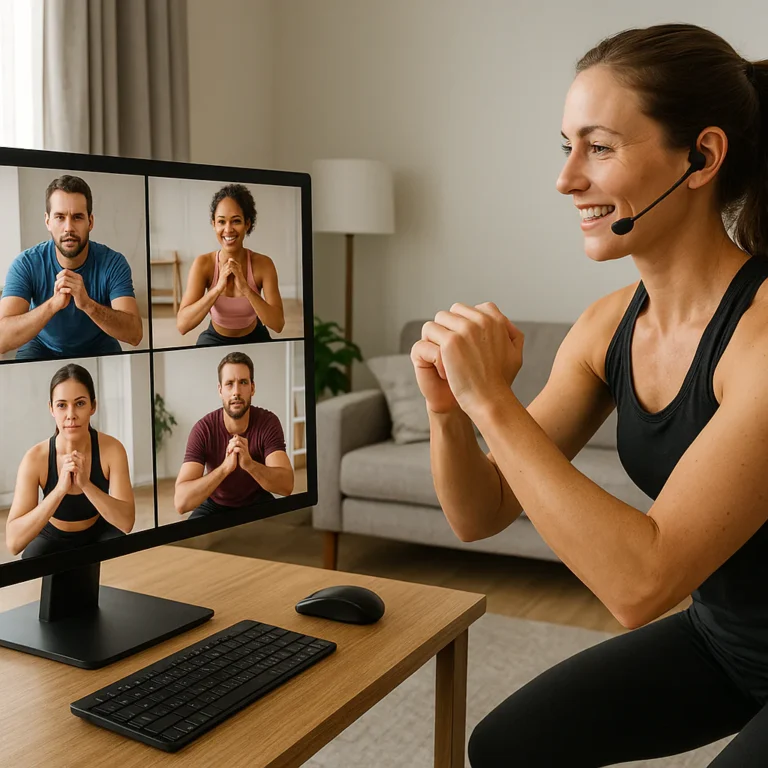
Semi-private training typically means a small number of participants share a coach. Group classes can make exercise social and lively, but individual correction may be more limited than in a one-to-one session.
Ask how the coach handles different fitness levels. Good group instruction includes:
- Easier and harder exercise options.
- Clear demonstrations and rest guidance.
- A way to ask questions.
- Safety cues that apply to the whole group.
- A plan for participants who need to stop or modify.
If you need close, individualized technique feedback, a one-to-one session may be a better starting point.
On-demand workouts and hybrid coaching
Some services combine scheduled video calls with an app, written program, messaging, or workout library. Apps such as Trainerize and TrueCoach are examples of platforms trainers may use to share workouts and track client activity. The platform itself is not the coach: the quality of your program and feedback depends on the person designing and reviewing it.
Hybrid coaching can be helpful if you want live instruction once in a while but prefer to train independently between appointments. Ask how often your coach reviews logs and how quickly you can expect feedback.
Explore more tools in our Fitness App Reviews collection.
🎯 Choosing Workouts for Your Goals, Fitness Level, and Schedule
A trainer should connect workout choices to your goal, available time, experience, recovery, and preferences. If you hate every session, the plan needs a conversation—not a motivational poster.
Weight loss, muscle building, and general fitness
Different goals can overlap, but emphasis matters.
| Goal | Common training emphasis | Useful progress markers |
|---|---|---|
| Build strength or muscle | Progressive resistance training and adequate recovery | Load, repetitions, movement quality, consistency |
| Improve cardiovascular fitness | Regular aerobic activity, sometimes intervals | Duration, pace, perceived effort, recovery |
| Support weight management | Sustainable activity plus broader nutrition and lifestyle habits | Activity consistency, strength, energy, health markers |
| Improve mobility and balance | Controlled practice, strength through comfortable ranges, balance work | Comfort, control, confidence, functional tasks |
| General fitness | A balanced mix of strength, cardio, and mobility | Attendance, capacity, daily function, wellbeing |
Exercise is one part of health and weight management. A coach should avoid promising a specific amount of weight loss or suggesting that a workout cancels out food. For more wellbeing guidance, see our Health and Wellness Tips.
Beginer, intermediate, and advanced workout options
Your “level” is not a permanent label. It depends on the movement, your recent training, and how you feel that day. A seasoned cyclist might be a beginner at weightlifting; an experienced lifter may be new to yoga.
A thoughtful trainer can adjust:
- Movement complexity: use a simpler variation when learning.
- Range of motion: work within a controlled, comfortable range.
- Resistance: reduce or increase load as technique and effort allow.
- Volume: change sets, repetitions, or session length.
- Rest: allow more recovery when needed.
- Intensity: make a session easier after poor sleep, illness, or unusual fatigue.
Progress should be gradual enough that you can maintain good form and recover. You do not need to feel wrecked after every session for a workout to “count.”
Training at home with or without equipment
A clear patch of floor, a sturdy chair, and a stable internet connection can be enough to get started. For strength training, equipment can broaden your options, but it’s not a requirement for every workout.
| Equipment | Useful for | Home-use note |
|---|---|---|
| Exercise mat | Floor work and yoga | Keep it on a stable, non-slip surface |
| Resistance bands | Rows, presses, and mobility exercises | Check for wear; secure them safely |
| Dumbells | Progressive strength training | Store them where they cannot roll or trip you |
| Kettlebell | Hinges, carries, and some strength work | Learn technique before dynamic movements |
| Yoga blocks or strap | Pose modifications and support | Optional; a trainer can suggest alternatives |
| Stable chair | Sit-to-stands, balance support, seated exercise | Use a chair that will not slide |
Brands such as TheraBand, TRX, Manduka, and Bowflex make commonly used fitness products. Follow manufacturer instructions and ask your coach whether a specific item suits your plan.
Home-safety check before training:
- Clear loose rugs, cords, pets, and clutter from your exercise area.
- Make sure the floor and any chair or step are stable.
- Keep water and your phone within reach.
- Put the camera far enough back to show the movement.
- Test your sound and connection before the session starts.
🗓️ What a Virtual Training Plan May Include
A thoughtful plan is more than a calendar of sweaty rectangles. It should explain what you’re doing, how to progress, and how to adjust when life inevitably rearranges your week.
Assessment, goal setting, and workout programming
Your trainer may ask about:
- Your goals and why they matter to you.
- Previous exercise experience.
- Equipment, space, and scheduling constraints.
- Current or past injuries and health considerations.
- Activities you enjoy—or strongly prefer to avoid.
- How you’ll recognize progress.
A trainer should not diagnose a medical issue or replace a clinician. They can, however, ask enough questions to decide whether a particular exercise falls within their scope or whether you should first get medical advice.
Progressive overload, recovery, and rest days
Progressive overload means gradually adjusting training demands as you adapt. That might mean a little more resistance, an extra repetition, improved control, more range, or a slightly longer session—not necessarily adding weight every week.
Recovery is part of training. If you combine yoga and weightlifting, your total workload matters. The featured video’s schedule proposes alternating weights and yoga days, with a rest day and a gentler alternative cycle for people who find the first schedule too demanding. It also suggests aiming for roughly 100 minutes of yoga weekly. Treat that as the video speaker’s suggested target, not a universal evidence-based requirement: your ideal frequency depends on your needs, training load, and recovery.
A practical example for someone with limited experience might be:
| Day | Example session |
|---|---|
| Monday | Full-body strength |
| Tuesday | Gentle yoga or walking |
| Wednesday | Rest or easy mobility |
| Thursday | Full-body strength |
| Friday | Yoga or light cardio |
| Saturday | Optional walk or recreation |
| Sunday | Rest |
More experienced exercisers may handle additional sessions, while beginners or people returning after a break may need more recovery. Muscle soreness can happen; sharp pain, worsening joint pain, or soreness that disrupts normal movement calls for a change of plan.
Exercise demonstrations, feedback, and form checks
Remote form coaching relies on communication and camera setup. Before a session:
- Position your camera so your trainer can see the full movement.
- Ask whether a side or front view is more useful.
- Wear clothing that allows comfortable movement.
- Use enough light for the coach to see you clearly.
- Tell the trainer immediately if a cue is unclear or causes discomfort.
A trainer may ask you to perform a practice repetition, adjust your stance, or switch angles. They cannot feel your balance, test an injury, or physically guide your body through a movement. When a movement is difficult to observe remotely, your coach should choose a safer alternative rather than pretending the camera can do everything.
🛡️ Safety, Modifications, and Working Around Injuries
Safety is a collaboration between you, your coach, and—when appropriate—your healthcare team. Share relevant restrictions and stop if you feel symptoms that are new, severe, or concerning.
A sensible safety checklist
- Start at a level you can control.
- Warm up with a few minutes of easy movement.
- Prioritize technique over more repetitions or longer stretches.
- Keep your training area clear.
- Tell your trainer about pain, dizziness, unusual shortness of breath, or other concerning symptoms.
- Stop a movement that causes sharp or worsening pain.
- Seek medical advice when symptoms persist or your health history calls for it.
For people affected by breast cancer treatment, Breastcancer.org’s exercise-safety guidance describes the importance of clinician guidance, gradual progression, and individualized modifications. It discusses the PAL trial, in which carefully progressive weight training was associated with improved strength and other outcomes for participants. Those findings do not mean every exercise is appropriate for every survivor; treatment history, symptoms, lymphedema risk, and medical advice matter.
Breastcancer.org also cautions that some yoga positions can place substantial weight on the arms and shoulders, and suggests working with appropriately informed instructors on modifications. This is a useful example of why “yoga is gentle” and “lifting is unsafe” are both too simplistic. The right movement and progression depend on the person.
The source’s memorable advice is worth keeping close: “Perfect form is better than holding a stretch for longer or doing more reps of an exercise.” When in doubt, scale the movement and consult a qualified professional.
💻 Technology and Home Workout Setup
You don’t need a studio with a ring light and a wall of matching kettlebells. You do need a reliable way to communicate and enough room to move.
Before your first online workout
- Check your connection: use a stable Wi-Fi connection where possible.
- Secure your device: place your phone, tablet, or laptop on a steady stand.
- Frame your body: the coach should see the movement being practiced.
- Test audio: keep the trainer’s instructions audible while you move.
- Clear the area: make room for standing, floor-based, and side-to-side movement.
- Prepare equipment: arrange weights or bands before the workout begins.
If your connection drops, pause rather than guessing what comes next—especially during unfamiliar movements or heavy lifting. Ask your trainer how they handle technical interruptions and what backup plan they use.
🤝 Finding the Right Virtual Personal Trainer
The right trainer is more than a cheerful face in a video call. They should understand your goals, communicate clearly, respect their professional scope, and adapt sessions to your real-life setup.
Credentials, coaching style, and specialty expertise
Ask about credentials, experience, and any specialty training relevant to your needs. Common fitness certifications include those offered by organizations such as ACE, NASM, and ACSM. Certification alone doesn’t guarantee a perfect fit, but it gives you a useful starting point.
Look for a coach who:
- Listens before prescribing a plan.
- Explains how exercises relate to your goals.
- Offers modifications without making you feel like you’ve failed.
- Tracks progress beyond “that looked hard.”
- Encourages medical or allied-health input when a concern falls outside their scope.
- Can coach your preferred style, whether that is strength, yoga, cardio, or a blend.
Questions to ask before your first session
- What training styles do you coach most often?
- How do you adapt a workout if I have limited equipment?
- How do you give feedback on form over video?
- What information do you need about injuries or medical restrictions?
- How do you track progress and decide when to advance a program?
- What happens if I need to modify or stop an exercise?
- Is the service live coaching, recorded content, or a combination?
Reviews can offer clues about punctuality, communication, and the client experience, but don’t treat any single testimonial as proof that a program will suit you. Look for consistent patterns and ask for details about the coaching format. For more exercise ideas and encouragement, browse our Fitness Motivation and Fitness Industry News sections.
✅ Quick Tips for Getting the Most From Online Workouts
- Tell your coach what you actually want. “Feel stronger carrying groceries” is a perfectly good goal.
- Choose a workout you can repeat. Consistency is less glamorous than a surprise burpee test, and far more useful.
- Use modifications early. Scaling an exercise is smart coaching, not cheating.
- Keep a simple training log. Record the workout, effort, equipment, and any discomfort.
- Speak up about pain or confusion. Your trainer cannot read your mind through the screen.
- Balance hard work with recovery. More sessions are not automatically better sessions.
- Revisit your plan. Your goals, schedule, and preferences can change; your program can change too.